Everything You Need to Know about GABAGOOL – But was Afraid to Ask

 “BUT Was AFRAID to ASK” !!!


TONY & HIS GABAGOOL

“I LOVE GABAGOOL”

If you’re a fan of The Sopranos, you’ve likely adopted the term “gabagool” after hearing the clan discuss their love of cured meats every few episodes. If you were to order gabagool at a typical restaurant, you may receive some furrowed brows, but if you’re in a region with a large Italian-American population, like New Jersey, they’ll have a platter of capicola in front of you in no time.

Capicola, which SBS describes as a “moist and tender” cured meat made from the neck of a pig, is a delicious addition to charcuterie platters and antipasto, and is often served alongside other Italian meats such as prosciutto and salami. While many Americans have had a taste of this salty cured meat before, they probably don’t introduce it to their party guests as gabagool unless they’re Italian-American. So, where in the world did this word originate from and what does it actually mean? 

The word gabagool was born when a variety of Italian dialects merged, but what it translates to in Italian is: nothing. Atlas Obscura confirms that gabagool is just a mutation of the word capicola, spoken with a very specific accent.

Naples-born linguistics professor Mariapaola D’Imperio explains to Atlas Obscura that Italian linguistics is far from straightforward. The Italian language, D’Imperio notes, was initially a smorgasbord of multiple dialects. Each old Italian “kingdom” spoke its own variation of the language up until unification, when Italian officials picked one language, known as Standard Italian, to make communication easier.

Italian-Americans — those responsible for the notorious term gabagool — speak an Italian that is nowhere near Standard Italian, claims Atlas Obscura. “Instead it’s a construction of the frozen shards left over from languages that don’t even really exist in Italy any more, with minimal intervention from modern Italian,” writes Atlas Obscura’s Dan Nosowitz. Regardless of the language’s progression, Italian-Americans on the East Coast can all agree that gabagool is capicola.

Over the years the Italian language in America has morphed into something new, and Italian-Americans continue to celebrate their heritage by not always speaking the language, but as Nosowitz puts it, “putting on an antiquated accent for a dead sub-language to order some cheese.” Or, of course, cured meat.

That said, we’re here to talk about capicola. It’s just one of many types of cured meats, and it’s probably one you’ve heard mentioned a lot on a certain sort of television show. Chances are pretty good you may have heard about it more than you’ve had it, and it’s definitely not a more mainstream sort of cured meat, like bacon. So what, exactly, is it? It is as unhealthy — and delicious — as bacon? What makes it different from all the other types of cured meats out there? Is it as authentically Italian as it seems, or is it just pretending?

 Let’s find out.

Let’s clear up a big one here — what exactly are you eating when you take a bite of capicola? It’s actually impressively specific. 

We’ll start with where it comes from, and according to DePalma Salumi, capicola (or capocollo) is one of a number of types of cured Italian meats. This one comes specifically from the area of the pig between the neck and the fourth or fifth rib of the pork shoulder. That’s what the word means, in fact: “capo” means “head” and “collo” means “neck.” Academia Barilla gets even more specific and says the pigs of choice are at least eight months old and weigh at least 300 pounds. Traditionally, the best of the best comes from large breeds typically raised in the south of Italy. 

In case you’re wondering what makes this part of these pigs so special, SBS says it’s all because of the fat ratio. Capicola is 30 percent fat and 70 percent lean, and that means it’s both tender and moist, even after it’s been cured.

Cured meats are nothing new, and capicola definitely isn’t new. According to Academia Barilla, capicola goes back to the era of the colonies of the Magna Graecia… but what does that mean?

For that answer, we’ll need to turn to the Ancient History Encyclopedia. The Magna Graecia were areas along the coast of southern Italy that were colonized by the Greeks between the 8th and 5th centuries BC. We did say it’s been around a long, long time! 

These ancient Greeks were attracted to the area by the particularly fertile lands and its perfect position within a larger trade network, and when they settled there, they made it completely Greek. Not only did they bring things like the Olympic Games

, but they also brought stuffed pork sausages. That kicked off the start of the area’s deep love of all things pork, and they’re still known for their large-breed pigs and their pork products today — including capicola.


CAPICOLA !

aka “GABAGOOL” !!!


Capicola, coppa, capocollo… which one is it?

These ancient Greeks were attracted to the area by the particularly fertile lands and its perfect position within a larger trade network, and when they settled there, they made it completely Greek. Not only did they bring things like the Olympic Games, but they also brought stuffed pork sausages. That kicked off the start of the area’s deep love of all things pork, and they’re still known for their large-breed pigs and their pork products today — including capicola.

Capicola, coppa, capocollo… which one is it?

The Reason Some People Refer To Capicola As Gabagool

If you’re a fan of The Sopranos, you’ve likely adopted the term “gabagool” after hearing the clan discuss their love of cured meats every few episodes. If you were to order Gabagool at a typical restaurant, you may receive some furrowed brows, but if you’re in a region with a large Italian-American population, like New Jersey, they’ll have a platter of capicola in front of you in no time.

Capicola, which SBS describes as a “moist and tender” cured meat made from the neck of a pig, is a delicious addition to charcuterie platters and antipasto, and is often served alongside other Italian meats such as prosciutto and salami. While many Americans have had a taste of this salty cured meat before, they probably don’t introduce it to their party guests as gabagool unless they’re Italian-American. So, where in the world did this word originate from and what does it actually mean? 

The word gabagool was born when a variety of Italian dialects merged, but what it translates to in Italian is: nothing. Atlas Obscura confirms that gabagool is just a mutation of the word capicola, spoken with a very specific accent.


The Italian-American dialect has a complex history

Naples-born linguistics professor Mariapaola D’Imperio explains to Atlas Obscura that Italian linguistics is far from straightforward. The Italian language, D’Imperio notes, was initially a smorgasbord of multiple dialects. Each old Italian “kingdom” spoke its own variation of the language up until unification, when Italian officials picked one language, known as Standard Italian, to make communication easier.
Italian-Americans — those responsible for the notorious term gabagool — speak an Italian that is nowhere near Standard Italian, claims Atlas Obscura. “Instead it’s a construction of the frozen shards left over from languages that don’t even really exist in Italy any more, with minimal intervention from modern Italian,” writes Atlas Obscura’s Dan Nosowitz. Regardless of the language’s progression, Italian-Americans on the East Coast can all agree that gabagool is capicola.

Over the years the Italian language in America has morphed into something new, and Italian-Americans continue to celebrate their heritage by not always speaking the language, but as Nosowitz puts it, “putting on an antiquated accent for a dead sub-language to order some cheese.” Or, of course, cured meat.

There’s no denying that cured meats are delicious. Whether you’re piling them on a sandwich or serving them up on a platter, there’s just something about them that makes you crave more. But unfortunately, there have been numerous studies on just how bad for you processed meats really are (via Science Direct). 

That said, we’re here to talk about capicola. It’s just one of many types of cured meats, and it’s probably one you’ve heard mentioned a lot on a certain sort of television show. Chances are pretty good you may have heard about it more than you’ve had it, and it’s definitely not a more mainstream sort of cured meat, like bacon. So what, exactly, is it? It is as unhealthy — and delicious — as bacon? What makes it different from all the other types of cured meats out there? Is it as authentically Italian as it seems, or is it just pretending? Let’s find out!

What is capicola?

Let’s clear up a big one here — what exactly are you eating when you take a bite of capicola? It’s actually impressively specific. 

We’ll start with where it comes from, and according to DePalma Salumi, capicola (or capocollo) is one of a number of types of cured Italian meats. This one comes specifically from the area of the pig between the neck and the fourth or fifth rib of the pork shoulder. That’s what the word means, in fact: “capo” means “head” and “collo” means “neck.” Academia Barilla gets even more specific and says the pigs of choice are at least eight months old and weigh at least 300 pounds. Traditionally, the best of the best comes from large breeds typically raised in the south of Italy. 


In case you’re wondering what makes this part of these pigs so special, SBS says it’s all because of the fat ratio. Capicola is 30 percent fat and 70 percent lean, and that means it’s both tender and moist, even after it’s been cured.


TONY SOPRANOS GABAGOOL

SANDWICH


Capicola has been around for almost forever.

Cured meats are nothing new, and capicola definitely isn’t new. According to Academia Barilla, capicola goes back to the era of the colonies of the Magna Graecia… but what does that mean?

For that answer, we’ll need to turn to the Ancient History Encyclopedia. The Magna Graecia were areas along the coast of southern Italy that were colonized by the Greeks between the 8th and 5th centuries BC. We did say it’s been around a long, long time! 


SUNDAY SAUCE
RECIPES – SUNDAY SAUCE
LASAGNA – MEATBALLS
“HOW to Make a GABAGOOL SANDWICH”
And MUCH MORE …


These ancient Greeks were attracted to the area by the particularly fertile lands and its perfect position within a larger trade network, and when they settled there, they made it completely Greek. Not only did they bring things like the Olympic Games, but they also brought stuffed pork sausages. That kicked off the start of the area’s deep love of all things pork, and they’re still known for their large-breed pigs and their pork products today — including capicola.

Capicola, coppa, capocollo… which one is it?

There are a lot of different terms you’ve probably heard used to refer to various meats, and a lot of them sound very, very similar to “capicola.” Let’s clear up any potential confusion with help from DiBruno Bros. 

At the root of the confusion is the fact that many regions in Italy have their own version of capicola, and some are very specific just to that area. (Think of champagne — the real stuff only comes from the Champagne region in France, otherwise it’s more accurately described as sparkling wine.) For example, Coppa Piacentina involves stuffing the meat into a casing of intestine, and Coppa di Calabria uses wine in the process… and they’re both kinds of Italian capicola. The version that’s made in America is a little different, though, and it’s made with either red pepper or black peppercorn. 

Then, there’s ham capocollo, which is also called ham-capi and it’s also a different thing. That’s essentially a spiced and boiled ham, and it’s said to be a cross between ham and capicola. Confusing, right?

There are still other types of coppa/capocollo/capicola, says DeLallo. The region of Umbria uses coriander and fennel, while Basilicata traditionally uses hot pepper powder, and their version is typically not as salty or smoky as the stuff from Calabria. The long and short of it is yes, there are different varieties and they come from different regions. 

What makes Capicola different from other thin, cured meats — like Prosciutto?


Cured meats all go through a similar process of washing, salting, and drying… so what makes capicola different from other thin-sliced, cured meats?

Essentially, it’s where the meat comes from on the pig that makes it different, says the Huffington Post. Take prosciutto. That comes from the pig’s hind leg, and it cures for anywhere from nine months to two years. Speck also comes from the hind leg, but it’s made using different spices and it’s cold smoked after it’s cured. Speck, prosciutto, and capicola can all be used pretty interchangeably, but they’re going to taste different and capicola is from an entirely different part of the pig.
What about soppressata? That can come from pretty much any part of the pig, and it can even include “leftover” bits like the head and tongue. Serrano ham? That’s Spanish, and it can only be called that if it’s from a certain breed of pig, the Landrace. (Similarly, Iberico ham has to come from Iberico pigs.)

The confusing part isn’t over just yet — it’s also worth talking about the two different ways capicola is made. Bear with us. 

Technically, says The Daring Gourmet, capicola (or capocollo) refers to the thin-sliced neck and shoulder meat that’s been cooked. When that piece of neck and shoulder meat is dry-cured, it’s more appropriately called coppa… although in the U.S., the terms are often used interchangeably. If you order capicola at your local deli counter, you might just get the dry-cured stuff. 

So, what does it mean when we talk about the process of dry-curing? Again, this is also different based on region and tradition, but essentially, DeLallo says that the process involves taking your piece of meat, adding salt and other spices, then putting into a natural casing, tying it up, and letting it age for at least several months. 

And here’s why Italy is so good at making these types of meats. According to Academia Barilla, the combination of humidity and temperature found in particular areas of Italy make it perfect for slow aging, as there’s little to no risk of the development of mold.


The Reason Some People Refer To Capicola As Gabagool

If you’re a fan of The Sopranos, you’ve likely adopted the term “Gabagool” after hearing the clan discuss their love of cured meats every few episodes. If you were to order gabagool at a typical restaurant, you may receive some furrowed brows, but if you’re in a region with a large Italian-American population, like New Jersey, they’ll have a platter of capicola in front of you in no time.

Capicola, which SBS describes as a “moist and tender” cured meat made from the neck of a pig, is a delicious addition to charcuterie platters and antipasto, and is often served alongside other Italian meats such as prosciutto and salami. While many Americans have had a taste of this salty cured meat before, they probably don’t introduce it to their party guests as gabagool unless they’re Italian-American. So, where in the world did this word originate from and what does it actually mean? 

The word gabagool was born when a variety of Italian dialects merged, but what it translates to in Italian is: nothing. Atlas Obscura confirms that gabagool is just a mutation of the word capicola, spoken with a very specific accent.
The Italian-American dialect has a complex history.
Naples-born linguistics professor Mariapaola D’Imperio explains to Atlas Obscura that Italian linguistics is far from straightforward. The Italian language, D’Imperio notes, was initially a smorgasbord of multiple dialects. Each old Italian “kingdom” spoke its own variation of the language up until unification, when Italian officials picked one language, known as Standard Italian, to make communication easier.


Italian-Americans — those responsible for the notorious term gabagool — speak an Italian that is nowhere near Standard Italian, claims Atlas Obscura. “Instead it’s a construction of the frozen shards left over from languages that don’t even really exist in Italy any more, with minimal intervention from modern Italian,” writes Atlas Obscura’s Dan Nosowitz. Regardless of the language’s progression, Italian-Americans on the East Coast can all agree that gabagool is capicola.

Over the years the Italian language in America has morphed into something new, and Italian-Americans continue to celebrate their heritage by not always speaking the language, but as Nosowitz puts it, “putting on an antiquated accent for a dead sub-language to order some cheese.” Or, of course, cured meat.


A Plate of CAPICOLA

There’s no denying that cured meats are delicious. Whether you’re piling them on a sandwich or serving them up on a platter, there’s just something about them that makes you crave more. But unfortunately, there have been numerous studies on just how bad for you processed meats really are (via Science Direct). 

That said, we’re here to talk about capicola. It’s just one of many types of cured meats, and it’s probably one you’ve heard mentioned a lot on a certain sort of television show. Chances are pretty good you may have heard about it more than you’ve had it, and it’s definitely not a more mainstream sort of cured meat, like bacon. So what, exactly, is it? It is as unhealthy — and delicious — as bacon? What makes it different from all the other types of cured meats out there? Is it as authentically Italian as it seems, or is it just pretending? Let’s find out!


What is Capicola?

Let’s clear up a big one here — what exactly are you eating when you take a bite of capicola? It’s actually impressively specific. 

We’ll start with where it comes from, and according to DePalma Salumi, capicola (or capocollo) is one of a number of types of cured Italian meats. This one comes specifically from the area of the pig between the neck and the fourth or fifth rib of the pork shoulder. That’s what the word means, in fact: “capo” means “head” and “collo” means “neck.” Academia Barilla gets even more specific and says the pigs of choice are at least eight months old and weigh at least 300 pounds. Traditionally, the best of the best comes from large breeds typically raised in the south of Italy. 


In case you’re wondering what makes this part of these pigs so special, SBS says it’s all because of the fat ratio. Capicola is 30 percent fat and 70 percent lean, and that means it’s both tender and moist, even after it’s been cured.

Capicola has been around for almost forever
Shutterstock
Cured meats are nothing new, and capicola definitely isn’t new. According to Academia Barilla, capicola goes back to the era of the colonies of the Magna Graecia… but what does that mean?

For that answer, we’ll need to turn to the Ancient History Encyclopedia. The Magna Graecia were areas along the coast of southern Italy that were colonized by the Greeks between the 8th and 5th centuries BC. We did say it’s been around a long, long time! 


These ancient Greeks were attracted to the area by the particularly fertile lands and its perfect position within a larger trade network, and when they settled there, they made it completely Greek. Not only did they bring things like the Olympic Games, but they also brought stuffed pork sausages. That kicked off the start of the area’s deep love of all things pork, and they’re still known for their large-breed pigs and their pork products today — including capicola.

Capicola, coppa, capocollo… which one is it?
Shutterstock
There are a lot of different terms you’ve probably heard used to refer to various meats, and a lot of them sound very, very similar to “capicola.” Let’s clear up any potential confusion with help from DiBruno Bros. 


At the root of the confusion is the fact that many regions in Italy have their own version of capicola, and some are very specific just to that area. (Think of champagne — the real stuff only comes from the Champagne region in France, otherwise it’s more accurately described as sparkling wine.) For example, Coppa Piacentina involves stuffing the meat into a casing of intestine, and Coppa di Calabria uses wine in the process… and they’re both kinds of Italian capicola. The version that’s made in America is a little different, though, and it’s made with either red pepper or black peppercorn. 

Then, there’s ham capocollo, which is also called ham-capi and it’s also a different thing. That’s essentially a spiced and boiled ham, and it’s said to be a cross between ham and capicola. Confusing, right?


There are still other types of coppa/capocollo/capicola, says DeLallo. The region of Umbria uses coriander and fennel, while Basilicata traditionally uses hot pepper powder, and their version is typically not as salty or smoky as the stuff from Calabria. The long and short of it is yes, there are different varieties and they come from different regions. 

What makes capicola different from other thin, cured meats — like prosciutto?
Cured meats all go through a similar process of washing, salting, and drying… so what makes capicola different from other thin-sliced, cured meats?

Essentially, it’s where the meat comes from on the pig that makes it different, says the Huffington Post. Take prosciutto. That comes from the pig’s hind leg, and it cures for anywhere from nine months to two years. Speck also comes from the hind leg, but it’s made using different spices and it’s cold smoked after it’s cured. Speck, prosciutto, and capicola can all be used pretty interchangeably, but they’re going to taste different and capicola is from an entirely different part of the pig.


What about soppressata? That can come from pretty much any part of the pig, and it can even include “leftover” bits like the head and tongue. Serrano ham? That’s Spanish, and it can only be called that if it’s from a certain breed of pig, the Landrace. (Similarly, Iberico ham has to come from Iberico pigs.)

Capicola may or may not be cooked
The confusing part isn’t over just yet — it’s also worth talking about the two different ways capicola is made. Bear with us. 

Technically, says The Daring Gourmet, capicola (or capocollo) refers to the thin-sliced neck and shoulder meat that’s been cooked. When that piece of neck and shoulder meat is dry-cured, it’s more appropriately called coppa… although in the U.S., the terms are often used interchangeably. If you order capicola at your local deli counter, you might just get the dry-cured stuff. 


We did say it was confusing! 

So, what does it mean when we talk about the process of dry-curing? Again, this is also different based on region and tradition, but essentially, DeLallo says that the process involves taking your piece of meat, adding salt and other spices, then putting into a natural casing, tying it up, and letting it age for at least several months. 

And here’s why Italy is so good at making these types of meats. According to Academia Barilla, the combination of humidity and temperature found in particular areas of Italy make it perfect for slow aging, as there’s little to no risk of the development of mold.

How to make capicola.
Capicola might be hard to find, depending on where you live, and it also might be pretty expensive. But there’s good news: you can absolutely make it at home.

All you’ll need is a pork shoulder, whatever seasonings you like (and since you’re doing it at home, there’s no need to be traditional), a curing salt mix, and casings. After seasoning your pork shoulder (with the marbling, without the fat cap), there are a few things you can do. You can wrap it tightly in plastic wrap and let it sit in your fridge for a few weeks before putting it into your casing, or you can cover it in salt and let it sit for one day for each two pounds of weight. 

Either way, it’s the aging process that’s the real key here. You’ll need somewhere to hang and age your capicola for months before you actually get to cut into it, and you’re going to want a place that holds a relatively high humidity but temperatures between 50 and 60 degrees Fahrenheit (via Sausage Maker). Complicated? A bit. A long process? Very. But rewarding? Absolutely.


CAPOCOLLO


So whay do they call it GABAGOOL ?


TONY SOPRANO
EATING “GABAGOOL”


If you know capicola from The Sopranos or The Office, you probably know it as “Gabagool” That’s… not even really close to the real word, so where the heck did this come from? 

Atlas Obscura says it’s because of a weird phenomenon: the development of an accent that’s not just regional, but it’s specific to the descendents of a group of Italian immigrants. The development of language in Italy is so confusing that even professional linguists aren’t sure what the heck happened, and we’re definitely not here to argue about linguistics, so we’ll talk basics. 

Essentially, most Italian immigrants came from different regions in southern Italy, and even when they settled in the U.S., they were still divided into regional groups. And those groups spoke different versions of their native language. When they came together in the U.S., bits and pieces of the languages held on, and formed a sort of Italian-American Italian language. 

When that happened, letters started taking on different sounds and inflections. Without getting too complicated, it’s all about accents and whether or not a letter’s sound comes from your vocal cords or your mouth. The hard “c” in “capicola” became a “g,” “p” shifted into a “b.” “o” got elongated to “ooh,” and — like in so many other words — the last vowel disappeared. 

Essentially, most Italian immigrants came from different regions in southern Italy, and even when they settled in the U.S., they were still divided into regional groups. And those groups spoke different versions of their native language. When they came together in the U.S., bits and pieces of the languages held on, and formed a sort of Italian-American Italian language. 

Capicola can be made anywhere, but there’s actually a few different types that are extra special. They’ve been awarded a Protected designation of origin (PDO) status, and that basically means that particular name can only be used if the entire product is made in a particular area or region.

Most capicola retains a heavy to slight smoky flavor, and DiBruno Bros. – who only carries capicola made in America — says that there are two different types of flavor profiles you might expect. It comes down to whatever spice mixture the maker decides to use, and while there’s some wiggle room in specifics, most American capicola is either made with red pepper — which will make it hot and spicy — or with black peppercorns, which will make it more on the sweeter side. 

Flavors are so varied that before you pick out a nice-looking side of capicola, you should definitely peek at the ingredients to get an idea of what flavor profile you’re looking at. Take some do-it-yourself recipes: While some call for paprika, chipotle powder, juniper, chili powder, and nutmeg, others might call for fennel, anise, red pepper, and coriander to compliment the base of black pepper. Bottom line? There’s one out there that’s perfect for you!


READ MORE on GABAGOOL

In SUNDAY SAUCE


SUNDAY SAUCE

PASTA –  MEATBALLS – GABAGOOL

AND MUCH MORE

Brief History of Italian New York


AL PACINO
SICILIAN AMERICAN
Native NEW YORK ITALIAN
BRONX, NEW YORK|

New York City has the largest population of Italian Americans in the United States of America as well as North America, many of whom inhabit ethnic enclaves in Brooklyn, the Bronx, Manhattan, Queens, and Staten Island. New York is home to the third largest Italian population outside of Italy, behind Buenos Aires, Argentina (first) and São Paulo, Brazil (second). Over 2.6 million[1] Italians and Italian-Americans live in the greater New York metro area, with about 800,000 living within one of the five New York City boroughs. This makes Italian Americans the largest ethnic group in the New York metro area.


The first Italian to reside in New York was Pietro Cesare Alberti, a Venetian seaman who, in 1635, settled in the Dutch colony of New Amsterdam that would eventually become New York. A small wave of Protestants, known as Waldensians, who were of French and northern Italian heritage (specifically Piedmontese), occurred during the 17th century, with the majority coming between 1654 and 1663.  A 1671 Dutch record indicates that, in 1656 alone, the Duchy of Savoy near Turin, Italy, had exiled 300 Waldensians due to their Protestant faith.

The largest wave of Italian immigration to the United States took place in the late 19th century and early 20th century. Between 1820 and 1978, 5.3 million Italians immigrated to the United States, including over two million between 1900 and 1910. Only Irish and Germans immigrated in larger numbers.

The first New York neighborhood to be settled by large numbers of Italian immigrants – primarily from Southern Italy (mostly from Sicily) – was East Harlem, which became the first part of the city to be known as “Little Italy”. The area, which lies east of Lexington Avenue between 96th and 116th Streets and east of Madison Avenue between 116th and 125th Streets, featured people from different regions of Italy on each cross street, as immigrants from each area chose to live in close proximity to each other.

“Italian Harlem” approached its peak in the 1930s, with over 100,000 Italian-Americans living in its crowded, run-down apartment buildings.  The 1930 census showed that 81 percent of the population of Italian Harlem consisted of first- or second- generation Italian Americans. This was somewhat less than the concentration of Italian Americans in the Lower East Side’s Little Italy with 88 percent; Italian Harlem’s total population, however, was three times that of Little Italy. Remnants of the neighborhood’s Italian heritage are kept alive by the Giglio Society of East Harlem. Every year on the second weekend of August, the Feast of Our Lady of Mount Carmel is celebrated and the “Dancing of the Giglio” is performed for thousands of visitors.

After World War II, the original Italian settlements such as East Harlem declined as Italian Americans moved to the North Bronx, Queens and Brooklyn’s southern tier. The geographic shift coincided with a new wave of Italian immigration. An estimated 129,000 to 150,000 Italian immigrants entered New York City between 1945 and 1973. Bypassing Manhattan, they settled in Italian American neighborhoods in the outer boroughs and helped reinvigorate Italian culture and community institutions. With the influx of postwar immigrants, Bensonhurst became the largest Italian community in New York City, with 150,000 Italian Americans in the 1980 census.

The best-known “Little Italy” in Manhattan is the area currently called that, which centers around Mulberry Street. This settlement, however, is rapidly becoming part of the adjacent Chinatown as the older Italian residents die and their children move elsewhere. As of the 2000 census, 692,739 New Yorkers reported Italian ancestry, making them the largest European ethnic group in the city. In 2011, the American Community Survey found there were 49,075 persons of Italian birth in New York. 


Charles “Lucky” Luciano

Charles Lucky Luciano was born in Lercara Friddi, Sicily.

His parents immigrated to New York when he was 9 years old.

The Luciano’s settled on East 1oth Street in the Lower East Side of Manhattan.

The neighborhood, a 100 years ago, when Lucky was growing up, was primarily
a Sicilian neighborhood, as well as Neapolitans, and Italian immigrants from Geno and Abruzzo as well.


Author Daniel Bellino “Z”
SICILIAN AMERICAN
Daniel Bellino Z, also lived in the East Village,which was known
as part of the Lower East Side when Lucky Luciano lived there.
Daniel lived on Avenue A at Saint Mark’s Place for 11 years, from 1982
to 1993. While living there, he worked 2 jobs for 7 years. He’d cook at French and Italian restaurants during the day, and at night he waited tables at John’s on 12th Street for 7 years. John’s opened in 1908 and is still in business today (2023). 
Not only did “Lucky” Luciano eat at John’s and Lanza’s around the block
on 1st Avenue, he is said to have “Whacked” (murdered) someone on the East 12th Street, right in front of John’s Sicilian Restaurant.
Lucky also frequent DeRoberti’s Pasticceria, a Sicilian Pastry Shop next toLanza’s Restaurant on 1st Avenue. Veneiro’s Italian Pastry Shop which opened on East 11th Street in 1890, is just about 50 feet away from Lanza’s and DeRoberti’s.
The BELLINO FAMILY
Giuseppina & Fillipo Bellino
Immigrated to New York from Lercara Friddi in 1906
The same years as the LUCINAO Family, both Families, along with
Martino Severino Sinatra (Frank’s Father) are from LERCARA FRIDDI, Sicily.
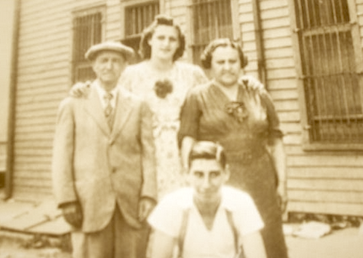
The Bellino’s; Fillipo, daughter Lucia – my Mother, Antonino and Giuseppina
are pictured here in Lodi, New Jersey, where they moved to, after 2 years in NYC
Fillipo opened a Shoemaker Shop on Main Street in Lodi, where there was a little
gambling room in the back, where local Italian men played cards and bet on Numbers.
FRANK SINATRA
Live at RADIO CITY MUSIC HALL
NEW YORK

SINATRA SAUCE
The COOOKBOOKS
Daniel Bellino Zwicke
COOK & EAT LIKE FRANK
HOS FAVORITE ITALIAN RECIPES

RECIPES From My SICILIAN NONNA
GIUSEPPINA SALEMI BELLINO
From LERCARA FRIDDI
And Other SICILIAN & ITALIAN RECIPES
SUNDAY SAUCE
WHEN ITALIAN AMERICANS COOK
aka The GODFATHER COOKBOOK
Martin Scorsese
Sicilian-American
Famed Italian-American director Martin Scorsese grew up in 
a 6 floor walk-up in a Sicilian Neighborhood on Elizabeth Street
just south of Houston Street with his Sicilian-American parents
Catherine and Charles Scorsese.
His ancestral Sicilian Family are from the town of Pollizzi Generosa
in the Province of Palermo, near the towns of Corleone and
Lercara Friddi, Sicily.


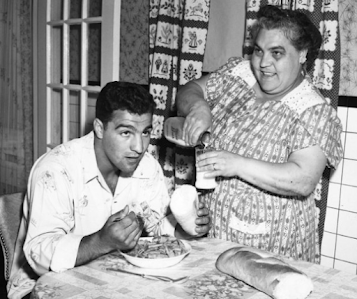
ROCKY MARCIANO Eats Pasta – alla Mamma


ROCKY MARCIANO


Rocky Marciano of the 150th Combat Engineers: World Heavyweight Boxing Champion
Rocco Francis Marchegiano, the son of Italian immigrants, was born and raised in Brockton Massachusetts. Rocco, a natural athlete, dropped out of high school in the 10th grade to help support his family. Rocco would go on to be professionally known as Rocky Marciano – the only heavyweight professional boxer to have finished his career undefeated.
According to the Department of Defense: “On March 4, 1943, at the age of 20, Rocky enlisted the Army in Boston, Massachusetts and was sent overseas to Europe. Marciano was assigned to the 150th Combat Engineers and stationed in Swansea, Wales where he helped ferry supplies across the English Channel to Normandy. The 150th went on to receive service stars for Normandy, North France, Rheinland, Ardennes-Alsace and Central Europe.”
“Marciano first took up boxing in the service, reportedly as a way to get out of kitchen duty. While awaiting discharge, Marciano, representing the Army, won the 1946 Amateur Armed Forces boxing tournament. After the war ended, he completed his service in March 1946 at Fort Lewis, Washington where he received an honorable discharge from the Army with the rank of Private First Class. Rocky returned home to Brockton, Massachusetts and continued to box as an amateur” -US Department of Defense
“On September 23, 1952, Marciano took on the World Heavyweight Champion Joe Walcott in Philadelphia. In round 13 Marciano knocked out Walcott to become the new Heavyweight Champion. Rocky was 29 years old. The two would meet again the following year with Marciano ending the match in the first round.”
“Rocky Marciano would go on to dominate the Heavyweight Division. On May 16, 1955, in San Francisco, Marciano went up against Don Cockell from the United Kingdom, who was also the boxing champion of Europe. Marciano knocked him out in round 9.”

“On April 27, 1956, Marciano announced his retirement at age 32, finishing his career at 49-0.”
On August 31, 1969, Rocky was a passenger in a private plane that crashed due to bad weather at a private airfield near Newton, Iowa. There were no survivors. Rocky Marciano was 45 years old at the time of his passing. He would have turned 46 years old on September 1.
Private First Class Rocky Marciano lies in rest at Forest Lawn Memorial Cemetery in Fort Lauderdale Florida. Lest We Forget


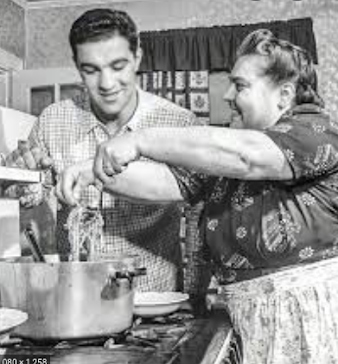
ROCKY’S MOM COOKING PASTA

ROCKY’S MOM
And ROCKY
MAMA MARCIANO TAKING CARE of HER BOY


COOK LIKE MAMA MARCIANO


SUNDAY SAUCE

WHEN ITALIAN AMERICNS COOK