Everything You Need to Know about GABAGOOL – But was Afraid to Ask

 “BUT Was AFRAID to ASK” !!!


TONY & HIS GABAGOOL

“I LOVE GABAGOOL”

If you’re a fan of The Sopranos, you’ve likely adopted the term “gabagool” after hearing the clan discuss their love of cured meats every few episodes. If you were to order gabagool at a typical restaurant, you may receive some furrowed brows, but if you’re in a region with a large Italian-American population, like New Jersey, they’ll have a platter of capicola in front of you in no time.

Capicola, which SBS describes as a “moist and tender” cured meat made from the neck of a pig, is a delicious addition to charcuterie platters and antipasto, and is often served alongside other Italian meats such as prosciutto and salami. While many Americans have had a taste of this salty cured meat before, they probably don’t introduce it to their party guests as gabagool unless they’re Italian-American. So, where in the world did this word originate from and what does it actually mean? 

The word gabagool was born when a variety of Italian dialects merged, but what it translates to in Italian is: nothing. Atlas Obscura confirms that gabagool is just a mutation of the word capicola, spoken with a very specific accent.

Naples-born linguistics professor Mariapaola D’Imperio explains to Atlas Obscura that Italian linguistics is far from straightforward. The Italian language, D’Imperio notes, was initially a smorgasbord of multiple dialects. Each old Italian “kingdom” spoke its own variation of the language up until unification, when Italian officials picked one language, known as Standard Italian, to make communication easier.

Italian-Americans — those responsible for the notorious term gabagool — speak an Italian that is nowhere near Standard Italian, claims Atlas Obscura. “Instead it’s a construction of the frozen shards left over from languages that don’t even really exist in Italy any more, with minimal intervention from modern Italian,” writes Atlas Obscura’s Dan Nosowitz. Regardless of the language’s progression, Italian-Americans on the East Coast can all agree that gabagool is capicola.

Over the years the Italian language in America has morphed into something new, and Italian-Americans continue to celebrate their heritage by not always speaking the language, but as Nosowitz puts it, “putting on an antiquated accent for a dead sub-language to order some cheese.” Or, of course, cured meat.

That said, we’re here to talk about capicola. It’s just one of many types of cured meats, and it’s probably one you’ve heard mentioned a lot on a certain sort of television show. Chances are pretty good you may have heard about it more than you’ve had it, and it’s definitely not a more mainstream sort of cured meat, like bacon. So what, exactly, is it? It is as unhealthy — and delicious — as bacon? What makes it different from all the other types of cured meats out there? Is it as authentically Italian as it seems, or is it just pretending?

 Let’s find out.

Let’s clear up a big one here — what exactly are you eating when you take a bite of capicola? It’s actually impressively specific. 

We’ll start with where it comes from, and according to DePalma Salumi, capicola (or capocollo) is one of a number of types of cured Italian meats. This one comes specifically from the area of the pig between the neck and the fourth or fifth rib of the pork shoulder. That’s what the word means, in fact: “capo” means “head” and “collo” means “neck.” Academia Barilla gets even more specific and says the pigs of choice are at least eight months old and weigh at least 300 pounds. Traditionally, the best of the best comes from large breeds typically raised in the south of Italy. 

In case you’re wondering what makes this part of these pigs so special, SBS says it’s all because of the fat ratio. Capicola is 30 percent fat and 70 percent lean, and that means it’s both tender and moist, even after it’s been cured.

Cured meats are nothing new, and capicola definitely isn’t new. According to Academia Barilla, capicola goes back to the era of the colonies of the Magna Graecia… but what does that mean?

For that answer, we’ll need to turn to the Ancient History Encyclopedia. The Magna Graecia were areas along the coast of southern Italy that were colonized by the Greeks between the 8th and 5th centuries BC. We did say it’s been around a long, long time! 

These ancient Greeks were attracted to the area by the particularly fertile lands and its perfect position within a larger trade network, and when they settled there, they made it completely Greek. Not only did they bring things like the Olympic Games

, but they also brought stuffed pork sausages. That kicked off the start of the area’s deep love of all things pork, and they’re still known for their large-breed pigs and their pork products today — including capicola.


CAPICOLA !

aka “GABAGOOL” !!!


Capicola, coppa, capocollo… which one is it?

These ancient Greeks were attracted to the area by the particularly fertile lands and its perfect position within a larger trade network, and when they settled there, they made it completely Greek. Not only did they bring things like the Olympic Games, but they also brought stuffed pork sausages. That kicked off the start of the area’s deep love of all things pork, and they’re still known for their large-breed pigs and their pork products today — including capicola.

Capicola, coppa, capocollo… which one is it?

The Reason Some People Refer To Capicola As Gabagool

If you’re a fan of The Sopranos, you’ve likely adopted the term “gabagool” after hearing the clan discuss their love of cured meats every few episodes. If you were to order Gabagool at a typical restaurant, you may receive some furrowed brows, but if you’re in a region with a large Italian-American population, like New Jersey, they’ll have a platter of capicola in front of you in no time.

Capicola, which SBS describes as a “moist and tender” cured meat made from the neck of a pig, is a delicious addition to charcuterie platters and antipasto, and is often served alongside other Italian meats such as prosciutto and salami. While many Americans have had a taste of this salty cured meat before, they probably don’t introduce it to their party guests as gabagool unless they’re Italian-American. So, where in the world did this word originate from and what does it actually mean? 

The word gabagool was born when a variety of Italian dialects merged, but what it translates to in Italian is: nothing. Atlas Obscura confirms that gabagool is just a mutation of the word capicola, spoken with a very specific accent.


The Italian-American dialect has a complex history

Naples-born linguistics professor Mariapaola D’Imperio explains to Atlas Obscura that Italian linguistics is far from straightforward. The Italian language, D’Imperio notes, was initially a smorgasbord of multiple dialects. Each old Italian “kingdom” spoke its own variation of the language up until unification, when Italian officials picked one language, known as Standard Italian, to make communication easier.
Italian-Americans — those responsible for the notorious term gabagool — speak an Italian that is nowhere near Standard Italian, claims Atlas Obscura. “Instead it’s a construction of the frozen shards left over from languages that don’t even really exist in Italy any more, with minimal intervention from modern Italian,” writes Atlas Obscura’s Dan Nosowitz. Regardless of the language’s progression, Italian-Americans on the East Coast can all agree that gabagool is capicola.

Over the years the Italian language in America has morphed into something new, and Italian-Americans continue to celebrate their heritage by not always speaking the language, but as Nosowitz puts it, “putting on an antiquated accent for a dead sub-language to order some cheese.” Or, of course, cured meat.

There’s no denying that cured meats are delicious. Whether you’re piling them on a sandwich or serving them up on a platter, there’s just something about them that makes you crave more. But unfortunately, there have been numerous studies on just how bad for you processed meats really are (via Science Direct). 

That said, we’re here to talk about capicola. It’s just one of many types of cured meats, and it’s probably one you’ve heard mentioned a lot on a certain sort of television show. Chances are pretty good you may have heard about it more than you’ve had it, and it’s definitely not a more mainstream sort of cured meat, like bacon. So what, exactly, is it? It is as unhealthy — and delicious — as bacon? What makes it different from all the other types of cured meats out there? Is it as authentically Italian as it seems, or is it just pretending? Let’s find out!

What is capicola?

Let’s clear up a big one here — what exactly are you eating when you take a bite of capicola? It’s actually impressively specific. 

We’ll start with where it comes from, and according to DePalma Salumi, capicola (or capocollo) is one of a number of types of cured Italian meats. This one comes specifically from the area of the pig between the neck and the fourth or fifth rib of the pork shoulder. That’s what the word means, in fact: “capo” means “head” and “collo” means “neck.” Academia Barilla gets even more specific and says the pigs of choice are at least eight months old and weigh at least 300 pounds. Traditionally, the best of the best comes from large breeds typically raised in the south of Italy. 


In case you’re wondering what makes this part of these pigs so special, SBS says it’s all because of the fat ratio. Capicola is 30 percent fat and 70 percent lean, and that means it’s both tender and moist, even after it’s been cured.


TONY SOPRANOS GABAGOOL

SANDWICH


Capicola has been around for almost forever.

Cured meats are nothing new, and capicola definitely isn’t new. According to Academia Barilla, capicola goes back to the era of the colonies of the Magna Graecia… but what does that mean?

For that answer, we’ll need to turn to the Ancient History Encyclopedia. The Magna Graecia were areas along the coast of southern Italy that were colonized by the Greeks between the 8th and 5th centuries BC. We did say it’s been around a long, long time! 


SUNDAY SAUCE
RECIPES – SUNDAY SAUCE
LASAGNA – MEATBALLS
“HOW to Make a GABAGOOL SANDWICH”
And MUCH MORE …


These ancient Greeks were attracted to the area by the particularly fertile lands and its perfect position within a larger trade network, and when they settled there, they made it completely Greek. Not only did they bring things like the Olympic Games, but they also brought stuffed pork sausages. That kicked off the start of the area’s deep love of all things pork, and they’re still known for their large-breed pigs and their pork products today — including capicola.

Capicola, coppa, capocollo… which one is it?

There are a lot of different terms you’ve probably heard used to refer to various meats, and a lot of them sound very, very similar to “capicola.” Let’s clear up any potential confusion with help from DiBruno Bros. 

At the root of the confusion is the fact that many regions in Italy have their own version of capicola, and some are very specific just to that area. (Think of champagne — the real stuff only comes from the Champagne region in France, otherwise it’s more accurately described as sparkling wine.) For example, Coppa Piacentina involves stuffing the meat into a casing of intestine, and Coppa di Calabria uses wine in the process… and they’re both kinds of Italian capicola. The version that’s made in America is a little different, though, and it’s made with either red pepper or black peppercorn. 

Then, there’s ham capocollo, which is also called ham-capi and it’s also a different thing. That’s essentially a spiced and boiled ham, and it’s said to be a cross between ham and capicola. Confusing, right?

There are still other types of coppa/capocollo/capicola, says DeLallo. The region of Umbria uses coriander and fennel, while Basilicata traditionally uses hot pepper powder, and their version is typically not as salty or smoky as the stuff from Calabria. The long and short of it is yes, there are different varieties and they come from different regions. 

What makes Capicola different from other thin, cured meats — like Prosciutto?


Cured meats all go through a similar process of washing, salting, and drying… so what makes capicola different from other thin-sliced, cured meats?

Essentially, it’s where the meat comes from on the pig that makes it different, says the Huffington Post. Take prosciutto. That comes from the pig’s hind leg, and it cures for anywhere from nine months to two years. Speck also comes from the hind leg, but it’s made using different spices and it’s cold smoked after it’s cured. Speck, prosciutto, and capicola can all be used pretty interchangeably, but they’re going to taste different and capicola is from an entirely different part of the pig.
What about soppressata? That can come from pretty much any part of the pig, and it can even include “leftover” bits like the head and tongue. Serrano ham? That’s Spanish, and it can only be called that if it’s from a certain breed of pig, the Landrace. (Similarly, Iberico ham has to come from Iberico pigs.)

The confusing part isn’t over just yet — it’s also worth talking about the two different ways capicola is made. Bear with us. 

Technically, says The Daring Gourmet, capicola (or capocollo) refers to the thin-sliced neck and shoulder meat that’s been cooked. When that piece of neck and shoulder meat is dry-cured, it’s more appropriately called coppa… although in the U.S., the terms are often used interchangeably. If you order capicola at your local deli counter, you might just get the dry-cured stuff. 

So, what does it mean when we talk about the process of dry-curing? Again, this is also different based on region and tradition, but essentially, DeLallo says that the process involves taking your piece of meat, adding salt and other spices, then putting into a natural casing, tying it up, and letting it age for at least several months. 

And here’s why Italy is so good at making these types of meats. According to Academia Barilla, the combination of humidity and temperature found in particular areas of Italy make it perfect for slow aging, as there’s little to no risk of the development of mold.


The Reason Some People Refer To Capicola As Gabagool

If you’re a fan of The Sopranos, you’ve likely adopted the term “Gabagool” after hearing the clan discuss their love of cured meats every few episodes. If you were to order gabagool at a typical restaurant, you may receive some furrowed brows, but if you’re in a region with a large Italian-American population, like New Jersey, they’ll have a platter of capicola in front of you in no time.

Capicola, which SBS describes as a “moist and tender” cured meat made from the neck of a pig, is a delicious addition to charcuterie platters and antipasto, and is often served alongside other Italian meats such as prosciutto and salami. While many Americans have had a taste of this salty cured meat before, they probably don’t introduce it to their party guests as gabagool unless they’re Italian-American. So, where in the world did this word originate from and what does it actually mean? 

The word gabagool was born when a variety of Italian dialects merged, but what it translates to in Italian is: nothing. Atlas Obscura confirms that gabagool is just a mutation of the word capicola, spoken with a very specific accent.
The Italian-American dialect has a complex history.
Naples-born linguistics professor Mariapaola D’Imperio explains to Atlas Obscura that Italian linguistics is far from straightforward. The Italian language, D’Imperio notes, was initially a smorgasbord of multiple dialects. Each old Italian “kingdom” spoke its own variation of the language up until unification, when Italian officials picked one language, known as Standard Italian, to make communication easier.


Italian-Americans — those responsible for the notorious term gabagool — speak an Italian that is nowhere near Standard Italian, claims Atlas Obscura. “Instead it’s a construction of the frozen shards left over from languages that don’t even really exist in Italy any more, with minimal intervention from modern Italian,” writes Atlas Obscura’s Dan Nosowitz. Regardless of the language’s progression, Italian-Americans on the East Coast can all agree that gabagool is capicola.

Over the years the Italian language in America has morphed into something new, and Italian-Americans continue to celebrate their heritage by not always speaking the language, but as Nosowitz puts it, “putting on an antiquated accent for a dead sub-language to order some cheese.” Or, of course, cured meat.


A Plate of CAPICOLA

There’s no denying that cured meats are delicious. Whether you’re piling them on a sandwich or serving them up on a platter, there’s just something about them that makes you crave more. But unfortunately, there have been numerous studies on just how bad for you processed meats really are (via Science Direct). 

That said, we’re here to talk about capicola. It’s just one of many types of cured meats, and it’s probably one you’ve heard mentioned a lot on a certain sort of television show. Chances are pretty good you may have heard about it more than you’ve had it, and it’s definitely not a more mainstream sort of cured meat, like bacon. So what, exactly, is it? It is as unhealthy — and delicious — as bacon? What makes it different from all the other types of cured meats out there? Is it as authentically Italian as it seems, or is it just pretending? Let’s find out!


What is Capicola?

Let’s clear up a big one here — what exactly are you eating when you take a bite of capicola? It’s actually impressively specific. 

We’ll start with where it comes from, and according to DePalma Salumi, capicola (or capocollo) is one of a number of types of cured Italian meats. This one comes specifically from the area of the pig between the neck and the fourth or fifth rib of the pork shoulder. That’s what the word means, in fact: “capo” means “head” and “collo” means “neck.” Academia Barilla gets even more specific and says the pigs of choice are at least eight months old and weigh at least 300 pounds. Traditionally, the best of the best comes from large breeds typically raised in the south of Italy. 


In case you’re wondering what makes this part of these pigs so special, SBS says it’s all because of the fat ratio. Capicola is 30 percent fat and 70 percent lean, and that means it’s both tender and moist, even after it’s been cured.

Capicola has been around for almost forever
Shutterstock
Cured meats are nothing new, and capicola definitely isn’t new. According to Academia Barilla, capicola goes back to the era of the colonies of the Magna Graecia… but what does that mean?

For that answer, we’ll need to turn to the Ancient History Encyclopedia. The Magna Graecia were areas along the coast of southern Italy that were colonized by the Greeks between the 8th and 5th centuries BC. We did say it’s been around a long, long time! 


These ancient Greeks were attracted to the area by the particularly fertile lands and its perfect position within a larger trade network, and when they settled there, they made it completely Greek. Not only did they bring things like the Olympic Games, but they also brought stuffed pork sausages. That kicked off the start of the area’s deep love of all things pork, and they’re still known for their large-breed pigs and their pork products today — including capicola.

Capicola, coppa, capocollo… which one is it?
Shutterstock
There are a lot of different terms you’ve probably heard used to refer to various meats, and a lot of them sound very, very similar to “capicola.” Let’s clear up any potential confusion with help from DiBruno Bros. 


At the root of the confusion is the fact that many regions in Italy have their own version of capicola, and some are very specific just to that area. (Think of champagne — the real stuff only comes from the Champagne region in France, otherwise it’s more accurately described as sparkling wine.) For example, Coppa Piacentina involves stuffing the meat into a casing of intestine, and Coppa di Calabria uses wine in the process… and they’re both kinds of Italian capicola. The version that’s made in America is a little different, though, and it’s made with either red pepper or black peppercorn. 

Then, there’s ham capocollo, which is also called ham-capi and it’s also a different thing. That’s essentially a spiced and boiled ham, and it’s said to be a cross between ham and capicola. Confusing, right?


There are still other types of coppa/capocollo/capicola, says DeLallo. The region of Umbria uses coriander and fennel, while Basilicata traditionally uses hot pepper powder, and their version is typically not as salty or smoky as the stuff from Calabria. The long and short of it is yes, there are different varieties and they come from different regions. 

What makes capicola different from other thin, cured meats — like prosciutto?
Cured meats all go through a similar process of washing, salting, and drying… so what makes capicola different from other thin-sliced, cured meats?

Essentially, it’s where the meat comes from on the pig that makes it different, says the Huffington Post. Take prosciutto. That comes from the pig’s hind leg, and it cures for anywhere from nine months to two years. Speck also comes from the hind leg, but it’s made using different spices and it’s cold smoked after it’s cured. Speck, prosciutto, and capicola can all be used pretty interchangeably, but they’re going to taste different and capicola is from an entirely different part of the pig.


What about soppressata? That can come from pretty much any part of the pig, and it can even include “leftover” bits like the head and tongue. Serrano ham? That’s Spanish, and it can only be called that if it’s from a certain breed of pig, the Landrace. (Similarly, Iberico ham has to come from Iberico pigs.)

Capicola may or may not be cooked
The confusing part isn’t over just yet — it’s also worth talking about the two different ways capicola is made. Bear with us. 

Technically, says The Daring Gourmet, capicola (or capocollo) refers to the thin-sliced neck and shoulder meat that’s been cooked. When that piece of neck and shoulder meat is dry-cured, it’s more appropriately called coppa… although in the U.S., the terms are often used interchangeably. If you order capicola at your local deli counter, you might just get the dry-cured stuff. 


We did say it was confusing! 

So, what does it mean when we talk about the process of dry-curing? Again, this is also different based on region and tradition, but essentially, DeLallo says that the process involves taking your piece of meat, adding salt and other spices, then putting into a natural casing, tying it up, and letting it age for at least several months. 

And here’s why Italy is so good at making these types of meats. According to Academia Barilla, the combination of humidity and temperature found in particular areas of Italy make it perfect for slow aging, as there’s little to no risk of the development of mold.

How to make capicola.
Capicola might be hard to find, depending on where you live, and it also might be pretty expensive. But there’s good news: you can absolutely make it at home.

All you’ll need is a pork shoulder, whatever seasonings you like (and since you’re doing it at home, there’s no need to be traditional), a curing salt mix, and casings. After seasoning your pork shoulder (with the marbling, without the fat cap), there are a few things you can do. You can wrap it tightly in plastic wrap and let it sit in your fridge for a few weeks before putting it into your casing, or you can cover it in salt and let it sit for one day for each two pounds of weight. 

Either way, it’s the aging process that’s the real key here. You’ll need somewhere to hang and age your capicola for months before you actually get to cut into it, and you’re going to want a place that holds a relatively high humidity but temperatures between 50 and 60 degrees Fahrenheit (via Sausage Maker). Complicated? A bit. A long process? Very. But rewarding? Absolutely.


CAPOCOLLO


So whay do they call it GABAGOOL ?


TONY SOPRANO
EATING “GABAGOOL”


If you know capicola from The Sopranos or The Office, you probably know it as “Gabagool” That’s… not even really close to the real word, so where the heck did this come from? 

Atlas Obscura says it’s because of a weird phenomenon: the development of an accent that’s not just regional, but it’s specific to the descendents of a group of Italian immigrants. The development of language in Italy is so confusing that even professional linguists aren’t sure what the heck happened, and we’re definitely not here to argue about linguistics, so we’ll talk basics. 

Essentially, most Italian immigrants came from different regions in southern Italy, and even when they settled in the U.S., they were still divided into regional groups. And those groups spoke different versions of their native language. When they came together in the U.S., bits and pieces of the languages held on, and formed a sort of Italian-American Italian language. 

When that happened, letters started taking on different sounds and inflections. Without getting too complicated, it’s all about accents and whether or not a letter’s sound comes from your vocal cords or your mouth. The hard “c” in “capicola” became a “g,” “p” shifted into a “b.” “o” got elongated to “ooh,” and — like in so many other words — the last vowel disappeared. 

Essentially, most Italian immigrants came from different regions in southern Italy, and even when they settled in the U.S., they were still divided into regional groups. And those groups spoke different versions of their native language. When they came together in the U.S., bits and pieces of the languages held on, and formed a sort of Italian-American Italian language. 

Capicola can be made anywhere, but there’s actually a few different types that are extra special. They’ve been awarded a Protected designation of origin (PDO) status, and that basically means that particular name can only be used if the entire product is made in a particular area or region.

Most capicola retains a heavy to slight smoky flavor, and DiBruno Bros. – who only carries capicola made in America — says that there are two different types of flavor profiles you might expect. It comes down to whatever spice mixture the maker decides to use, and while there’s some wiggle room in specifics, most American capicola is either made with red pepper — which will make it hot and spicy — or with black peppercorns, which will make it more on the sweeter side. 

Flavors are so varied that before you pick out a nice-looking side of capicola, you should definitely peek at the ingredients to get an idea of what flavor profile you’re looking at. Take some do-it-yourself recipes: While some call for paprika, chipotle powder, juniper, chili powder, and nutmeg, others might call for fennel, anise, red pepper, and coriander to compliment the base of black pepper. Bottom line? There’s one out there that’s perfect for you!


READ MORE on GABAGOOL

In SUNDAY SAUCE


SUNDAY SAUCE

PASTA –  MEATBALLS – GABAGOOL

AND MUCH MORE

Brief History of Italian New York


AL PACINO
SICILIAN AMERICAN
Native NEW YORK ITALIAN
BRONX, NEW YORK|

New York City has the largest population of Italian Americans in the United States of America as well as North America, many of whom inhabit ethnic enclaves in Brooklyn, the Bronx, Manhattan, Queens, and Staten Island. New York is home to the third largest Italian population outside of Italy, behind Buenos Aires, Argentina (first) and São Paulo, Brazil (second). Over 2.6 million[1] Italians and Italian-Americans live in the greater New York metro area, with about 800,000 living within one of the five New York City boroughs. This makes Italian Americans the largest ethnic group in the New York metro area.


The first Italian to reside in New York was Pietro Cesare Alberti, a Venetian seaman who, in 1635, settled in the Dutch colony of New Amsterdam that would eventually become New York. A small wave of Protestants, known as Waldensians, who were of French and northern Italian heritage (specifically Piedmontese), occurred during the 17th century, with the majority coming between 1654 and 1663.  A 1671 Dutch record indicates that, in 1656 alone, the Duchy of Savoy near Turin, Italy, had exiled 300 Waldensians due to their Protestant faith.

The largest wave of Italian immigration to the United States took place in the late 19th century and early 20th century. Between 1820 and 1978, 5.3 million Italians immigrated to the United States, including over two million between 1900 and 1910. Only Irish and Germans immigrated in larger numbers.

The first New York neighborhood to be settled by large numbers of Italian immigrants – primarily from Southern Italy (mostly from Sicily) – was East Harlem, which became the first part of the city to be known as “Little Italy”. The area, which lies east of Lexington Avenue between 96th and 116th Streets and east of Madison Avenue between 116th and 125th Streets, featured people from different regions of Italy on each cross street, as immigrants from each area chose to live in close proximity to each other.

“Italian Harlem” approached its peak in the 1930s, with over 100,000 Italian-Americans living in its crowded, run-down apartment buildings.  The 1930 census showed that 81 percent of the population of Italian Harlem consisted of first- or second- generation Italian Americans. This was somewhat less than the concentration of Italian Americans in the Lower East Side’s Little Italy with 88 percent; Italian Harlem’s total population, however, was three times that of Little Italy. Remnants of the neighborhood’s Italian heritage are kept alive by the Giglio Society of East Harlem. Every year on the second weekend of August, the Feast of Our Lady of Mount Carmel is celebrated and the “Dancing of the Giglio” is performed for thousands of visitors.

After World War II, the original Italian settlements such as East Harlem declined as Italian Americans moved to the North Bronx, Queens and Brooklyn’s southern tier. The geographic shift coincided with a new wave of Italian immigration. An estimated 129,000 to 150,000 Italian immigrants entered New York City between 1945 and 1973. Bypassing Manhattan, they settled in Italian American neighborhoods in the outer boroughs and helped reinvigorate Italian culture and community institutions. With the influx of postwar immigrants, Bensonhurst became the largest Italian community in New York City, with 150,000 Italian Americans in the 1980 census.

The best-known “Little Italy” in Manhattan is the area currently called that, which centers around Mulberry Street. This settlement, however, is rapidly becoming part of the adjacent Chinatown as the older Italian residents die and their children move elsewhere. As of the 2000 census, 692,739 New Yorkers reported Italian ancestry, making them the largest European ethnic group in the city. In 2011, the American Community Survey found there were 49,075 persons of Italian birth in New York. 


Charles “Lucky” Luciano

Charles Lucky Luciano was born in Lercara Friddi, Sicily.

His parents immigrated to New York when he was 9 years old.

The Luciano’s settled on East 1oth Street in the Lower East Side of Manhattan.

The neighborhood, a 100 years ago, when Lucky was growing up, was primarily
a Sicilian neighborhood, as well as Neapolitans, and Italian immigrants from Geno and Abruzzo as well.


Author Daniel Bellino “Z”
SICILIAN AMERICAN
Daniel Bellino Z, also lived in the East Village,which was known
as part of the Lower East Side when Lucky Luciano lived there.
Daniel lived on Avenue A at Saint Mark’s Place for 11 years, from 1982
to 1993. While living there, he worked 2 jobs for 7 years. He’d cook at French and Italian restaurants during the day, and at night he waited tables at John’s on 12th Street for 7 years. John’s opened in 1908 and is still in business today (2023). 
Not only did “Lucky” Luciano eat at John’s and Lanza’s around the block
on 1st Avenue, he is said to have “Whacked” (murdered) someone on the East 12th Street, right in front of John’s Sicilian Restaurant.
Lucky also frequent DeRoberti’s Pasticceria, a Sicilian Pastry Shop next toLanza’s Restaurant on 1st Avenue. Veneiro’s Italian Pastry Shop which opened on East 11th Street in 1890, is just about 50 feet away from Lanza’s and DeRoberti’s.
The BELLINO FAMILY
Giuseppina & Fillipo Bellino
Immigrated to New York from Lercara Friddi in 1906
The same years as the LUCINAO Family, both Families, along with
Martino Severino Sinatra (Frank’s Father) are from LERCARA FRIDDI, Sicily.
The Bellino’s; Fillipo, daughter Lucia – my Mother, Antonino and Giuseppina
are pictured here in Lodi, New Jersey, where they moved to, after 2 years in NYC
Fillipo opened a Shoemaker Shop on Main Street in Lodi, where there was a little
gambling room in the back, where local Italian men played cards and bet on Numbers.
FRANK SINATRA
Live at RADIO CITY MUSIC HALL
NEW YORK

SINATRA SAUCE
The COOOKBOOKS
Daniel Bellino Zwicke
COOK & EAT LIKE FRANK
HOS FAVORITE ITALIAN RECIPES

RECIPES From My SICILIAN NONNA
GIUSEPPINA SALEMI BELLINO
From LERCARA FRIDDI
And Other SICILIAN & ITALIAN RECIPES
SUNDAY SAUCE
WHEN ITALIAN AMERICANS COOK
aka The GODFATHER COOKBOOK
Martin Scorsese
Sicilian-American
Famed Italian-American director Martin Scorsese grew up in 
a 6 floor walk-up in a Sicilian Neighborhood on Elizabeth Street
just south of Houston Street with his Sicilian-American parents
Catherine and Charles Scorsese.
His ancestral Sicilian Family are from the town of Pollizzi Generosa
in the Province of Palermo, near the towns of Corleone and
Lercara Friddi, Sicily.


Italian Food in The Movies – with Recipes – Goodfellas The Godfather = Big Night


“Shove in your Saa – Seeg & Meatballs”


It all started with Pete Clemenza and The Godfather, a movie by Italian-American director Francis Ford Coppola. Yes, I guess we can say it started with Francis. It was Francis Ford Coppola who wrote the Screenplay along with the author of the Best Selling Novel – The Godfather, Mr. Mario Puzo, also an Italian-American. Coppola was the co author of The Godfather Screenplay along with Puzo. And it was Coppola who was the films director and decided what would be in the film and what wasn’t.

Coppola brilaintly sets the scene of Sonny Corleone meeting with his Capo’s and other Corleone Crime Family associates, discussing strtegies of their next moves after Virgil Sollozzo puts out a hit on Sonny’s father, Don Vito Corleone (Marlon Brand). The attempted assasination of Vito Corleone fails, and Vito Corleone is still alive, as his son Santino (Sonny) becomes the acting Boss of the Corleone Crime Family. 

As Sonny and his cronies discuss what to do, sitting around eating Chinese Food, his Capo, Peter Clemenza is making a pot of Italian Sunday Sauce Gravy with Sausages & Meatballs. Sonny’s younger brother Michael (Al Pacino) is in the room as well. He gets a call from his girlfriend Dianne, who ask Michael if she loves him. Michael doesn’t say it, but Clemenza being the smart old guy that he is, knows what has been said, and says, “Why don’t you tell that nice girl you Love her. I Love you with all of my Heart. If I don’t again soon, I’ma gonna Die” Clemenza chuckles.

Clemenza continues cooking his Sauce, then says to Michael, “Come over here kid. Learn something. You never know when you’re gonna to cook for 20 guys someday?  You see? You start out with a little oil. Then you fry some Garlic. Then you throw in some Tomatoes, some Tomato Paste, you fry it up. You make sure it doesn’t stick. You get it to a boil. You shove in all your Sausage, and your Meatballs. Add a little bit of wine. And a little sugar, and that’s my trick.”

Yes, Clemenza making Sunday Sauce and Meatballs was a favorite scene which just about everyone recalls and talks about, and for good reasons. It’s a great scene. But let us not forget some other scenes that included Italian food. At Connie Corleone’s Wedding, we have a Corleone associate throwing a Gabagool Sandwich to Paulie (watch the video below).

Also, let’s not forget Sonny tearing off a piece of Italian Bread, dipping it into the Sauce that Sonny’s mother has simmering on the stove. Then Sonny eats it. There are a couple scenes when the the wole Corleone Family is eating at the table. There’s the scene when Connie has cooked a meal for herself and her husband Carlo. One of Carlo’s girlfriends (Goomada) calls up asking for Carlo. Connie picks up the phone, then her and Carlo start fighting.


Another memorable scene that involved Italian Food was the meeting between Michael, Virgil Sollozzo, and Captain McCluskey at Louie’s Italian Restaurant in the Bronx. The three of them are sitting around the table when McCluskey asked Sollozzo, “How the Italian Food in this Restaurant?”
Sollozzo replies, “Get the Veal. It’s the best in the City”

Michael Corleone goes into the bathroom, and gets the gun that is planted for him inside the bathroom, above the toilet. Michael comes back out into the dining room and shoots and kills both Sollozzo and Captain McCluskey. The calmly drops the gun, and walks out of the restaurant.


MAKING SAUCE

CLEMENZA Shows MICHAEL How to Make SUNDAY SAUCE

ITALIAN GRAVY


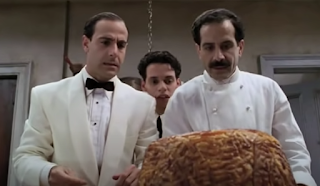
BIG NIGHT


In the annals of Italian Food in movies, Stanley Tucci’s Big Night is way up near the top. Some would probably put it on the top of their list. Yes when it comes to Italian Food in movies, Big Night is a heavyweight. The movie centers around two brothers from Italy, in their Italian Restaurant on the Jersey Shore, Louis Prima, and a monumental dish of Southern Italy, known as a Timpano (aka Timballo). 

The brothers restaurant is not doing that well financially. The food is very good, but this is the 1950s, and the locals don’t get Chef Primo’s authentic Italian Food. When a fellow (rival) restaurant owner tells brothers Scondo (Stanley Tucci) and Primo that he knows the famous Sicilian-American singer Louis Prima, and that he is going to get him to come to the brothers restaurant, this get the ball rolling on a very special dinner hosted by the brothers, featuring Chef Primo’s wonderful food, and the centerpiece of the meal, The Timpano, a luxurious dish made of baked maccheroni, meats, sauce, and cheeses stuffed into a dough shell that’s baked in a pan called a “Timpano” by which the dish gets his name. 

The movie stars Stanley Tucci as Secondo, Tony Shaloub as Primo, Secondo’s brother, Isabella Rossellini as Gabriella, with Minnie Driver, and Marc Anthony as the busboy.

The wonderful music, fine cast, and the scenes preparing the Timapno and other dishes is superb, and it’s these scenes that captivated audiences, and inspired to make their very own Big Night Style Italian Dinner Parties. The rest is history, and people still talk about Big Night, the Timpano, and wonderful Italian Dinner.


The TIMPANO

Stanley Tucci, Marc Anthony, & Tony Shaloub
BIG NIGHT


Goodfellas

Johnny (Frank Pelligrino Sr,) & Vinny (Charlie Scorsese)

DINNER in PRISON


GOODFELLAS


There are several Italian Food scenes in Martin Scorsese’s Goodfellas, a true life story of factions of the New York Mafia members and associates, based on Nick Pellegi’s book Wiseguy. Of course the most famous food scene is when Henry (Ray Liotta) is in Prison with Vinny (Charlie Scorsese), Johnny Dio, and “Big Paulie” (Paul Sorvino). Viiny is making the Sunday Sauce Italian Gravy with Meatballs and Pork Neck, as Johnny Dio cooks up some Steaks. The scene is quite memorable, and people talk about it all the time, especially the way Paul Sorvino shaves the Garlic “Ravor Thin” with a ravor, and Big Paulie telling Vinny, “Vinny don’t put too many Onions in the Sauce.” You gotta just Love it?

The scene with Henry making Veal Scallopine and his brother stirring “The Sauce” is memorable as well. 

So if you Love Movies, Italian Food, and Italian Food in movies, there’s a good chance you already know these films and the Food Scenes in them, and if you’re like me, you talk about them, and watch the movies over and over again. When you’ve got something good, you stick with it. And that’s The Godfather, Coppola and Pacino, Clemenza and his Sauce. Big Night Stanley Tucci and The Timpano, and Marty Scorsese’s Goodfellas, Robert DeNiro, The Prison Sauce, and the main character Henry Hill, and the late great Ray Liotta, who turned in such a great performance, he was even better than DeNiro. “Yes he was.”

Watch the movies, enjoy, make a Sunday Sauce, and listen to Sinatra. What’s better than that?
GOODFELLAS

PRISON DINNER


GOODFELLAS  “PRISON SAUCE” Recipe
JOHNNY DIO’S STEAK  –  Recipe


by Daniel Bellino Zwicke


SUNDAY SAUCE alla CLEMENZA

all PACINO

From The GODFATHER

“MAKE a BIG NIGHT TIMPANO”


NONNA BELLINO’S COOKBOOK

RECIPES FROM MY SICILIAN NONNA

Note :  Timpano is also known as TIMBALLO in most parts 
of Southern Italy, and there are numerous variations, and recipes,
like the one in Grandma Bellino’s Cookbook. 


iL TIMPANO

“BIG NIGHT”


The SINATRA COOKBOOK


SINATRA SAUCE

MUSIC MEATBALLS & MERRIEMENT

Daniel Bellino Z


CARLO & CONNIE FIGHT


Connie :  “Why don’t you bring your WHORE home for dinner” ?


Paulie’s Friend throws him a Gabagool Sandwich
“Hey Paulie! I got some Gabagool” !!!

At Connie Corleone’s Wedding

Paulie’s friend (Mobster) has a couple GABAGOOL (Capicola) Sandwiches

and throws one to Paulie, who says,  “Hey you Stupid Jerk” !

Watch this at Second 00.48 on the video clip.


“Don’t Overcook it.”

“You Overcook it, it Defeats its Own Purpose”

Robert DeNiro

RAGING BULL


PS  “And Let Us Not Forget RAGING BULL and the Steak Scene”


“It’s Like a Piece of CHARCOAL”

“BRING IT OVER” !!!


“YOU WANT YOUR STEAK” !!!!


Sinatra Pasta – Recipe – Tomato Sauce alla Sinatra


FRANK Makes PASTA

FRANK SINATRA Shows DINAH SHORE

HOW to MAKE TOMATO SAUCE

“SPAGHETTI POMODORO”


SPAGHETTI POMODORO 
This dish focuses on a “quick” sauce that tastes of fresh tomatoes rather than a long-simmered “gravy.” Patsy’s Italian Restaurant in NYC was where Sinatra famously kept a private table.
RECIPE “FRANK’S TOMATO SAUCE”
  • Ingredients:
  • 1 lb Spaghetti
  • 1 (28 oz) can Whole Peeled Tomatoes (preferably San Marzano), crushed by hand
  • 1/4 cup Extra-Virgin Olive Oil
  • 4–6 cloves Garlic, peeled and lightly smashed
  • Handful of Fresh Basil Leaves, torn
  • Kosher salt and black pepper to taste
  • Optional: Pinch of red pepper flakes 
  • Instructions:
  • Infuse the Oil: Heat olive oil in a large skillet over medium heat. Add the smashed garlic cloves and sauté for 2–3 minutes until golden brown. Sinatra’s Rule: Remove the garlic once it’s golden to leave only a subtle infusion.
  1. Start the Sauce: Carefully add the hand-crushed tomatoes and their juices to the oil. Add red pepper flakes if using. Simmer on medium-low for about 15–20 minutes, stirring occasionally, until the sauce slightly thickens but remains bright red.
  2. Cook Pasta: While the sauce simmers, cook spaghetti in a large pot of heavily salted boiling water until al dente (firm to the bite).
  3. Finish & Emulsify: Reserve 1/2 cup of pasta water, then drain the spaghetti. Add the pasta directly into the sauce skillet.
  4. Toss: Add the torn basil and a splash of the reserved pasta water. Toss vigorously over medium heat for 1 minute until the sauce coats every strand. Serve immediately. 
  5. Fettuccine à la Sinatra
  6. This is a decadent, Alfredo-style preparation that Sinatra often requested. It is defined by its simplicity—no flour or thickeners, just high-quality dairy and cheese.
  7. Prep time: 5 mins | Cook time: 15 mins | Servings: 4
Ingredients:
  • 1 lb Fettuccine (fresh is best if available)
  • 1/2 cup (1 stick) Unsalted Butter, softened
  • 1 cup Heavy Whipping Cream
  • 1 cup Parmesan Cheese, very finely grated
  • Salt and freshly cracked black pepper
  • Fresh parsley for garnish 
  • Instructions:
  1. Boil Pasta: Cook fettuccine in salted water until just al dente.
  2. Melt & Blend: While the pasta cooks, melt the butter in a large saucepan over low heat. Be careful not to let it brown.
  3. Create the Base: Slowly whisk in the heavy cream. Simmer gently for 2–3 minutes until slightly thickened, but do not let it reach a rolling boil.
  4. Add Cheese: Gradually whisk in the Parmesan cheese until the sauce is smooth and velvety. Season with salt and a generous amount of black pepper.
  5. Combine: Drain the pasta and add it to the sauce. Toss gently to coat.
  6. Rest & Serve: Remove from heat and let the pasta sit, covered, for 2 minutes—this allows the noodles to absorb the sauce. Garnish with parsley and serve on warm plates.


The SINATRA COOKBOOK

“SINATRA SAUCE”

COOK & EAT LIKE FRANK

His FAVORITE ITALIAN RECIPES


Books about Frank Sinatra – Biographies and Cookbook


SINATRA And The MAFIA MURDERS


Drawing on recently released secret files, an astonishing look at the extent to which Frank Sinatra’s life and career were inextricably linked with the Mafia, and how a number of innocent people died, simply because they knew Sinatra, or had upset him.

It was said of the young Frank Sinatra that he came across as ‘St Francis of Assisi with a shoulder holster’. In Frank Sinatra and the Mafia Murders, Mike Rothmiller and Douglas Thompson draw on previously secret Los Angeles Police intelligence files, a cache of FBI documents released to the authors in 2021 and extensive interviews with prime sources, including many who worked with Frank Sinatra and many more who tracked his long and fatal association with the American Mafia, notably his ongoing connection, after his original godfather was assassinated: Sam ‘Momo’ Giancana, who shared a lover with President John F. Kennedy.

Sixteen days after the assassination of John F. Kennedy on 30 November 1963, nineteen-year-old Frank Sinatra Jr. was kidnapped at gunpoint from his hotel room in Lake Tahoe, Nevada. A $240,000 ransom was demanded from his father. While the FBI and Nevada and California law-enforcement agencies sprang into action, Frank secretly contacted his Mafia friends for help. The Mafia believed they could free young Frank much more quickly through their underworld connections. Some of those they questioned died.

Revealed here as never before is the extent to which Sinatra was adopted by the Mafia. They promoted his career and ‘watched his back’ and, in return, Sinatra danced to their tune.  New information disclosed here shows that Sinatra also offered to spy for the CIA. Inside sources say Sinatra wanted the CIA to intercede to stop an investigation into his gaming licence in Las Vegas. But the CIA declined because they were already working with the Mob and were concerned Sinatra would learn of the Mafia’s connection to the CIA and leak it.


The BEST SINATRA COOKBOOK EVER !!!

“SINATRA SAUCE”

aka The SINATRA COOKBOOK

COOK & EAT LIKE FRANK

His FAVORITE ITALIAN RECIPES

And MORE …


SINATRA SAUCE “Music Meatballs & Merriment”

Daniel Bellino Zwicke


Sinatra Sauce “Music Metaballs & Merriment” and Living The Good Life. “Like Frank” .. Yes, it’s about Frank. That is one Francis Albert Sinatra, the Greatest Singer of The 20th Century, and Icon of American, especially of the Italian-American Enclave in America. Frank Sinatra was many things, first and foremost a Great Italian-American singer, Love & Adored by Millions. Mr. Sinatra was also an actor, citizen, and Entertainer Par Excellence. Yes this book is about those things, Frank Sinatra : the incomparable singer, actor, recording artist, Teen Idol of the 1940s, philanthropist, and Las Vegas & Nightclub Entertainer. He was like no other, Sinatra was one-of-a- kind, and he had a lust for life, “Hanging with Friends,” – sipping cocktails, with good food, and making good times. That’s what this book is about, Frank Sinatra, eating (Italian Food), enjoying a cocktail or two, and the company of family and friends. Yes, Frank Sinatra lived life to its fullest. He wouldn’t have it any other way, but “His Way.” 

This book “Inspires” and gives you the tools to live out your Sinatra Dreams. You can make it reality, with recipes of Frank’s Favorite Italian Foods, Pasta, Meatballs, Posillipo, Eggplant Parm and more. Eating, drinking, and having good times, all the time as Frank did. Meals with friends and family. Meals you can cook, with recipes in this book. The info and recipes are all here in Sinatra Sauce. Read it, put on some Sinatra (music), cook, eat, and create memorable times at the table, just like Frank. That’s what this book is about: Sinatra, Family, Friends, and Good Times. “The Best is Yet to Come”

Visit SINATRA SAUCE – The Website @ https://sinatrasauce.com

Author Daniel Bellino Zwicke is a lifelong Sinatra fan. He is a Best Selling author, who lives and writes in New York’s Greenwich Village. Daniel is currently working on several other projects. He has authored : Sunday Sauce, La Tavola, Mangia Italiano, Grandma Bellino’s Cookbook, Segreto Italiano, and Positano The Amalfi Coast – Travel Guide / Cookbook.

Recipes :

SINATRA TOMATO SAUCE

DOLLY’S MEATBALLS

EGGPLANT PARMIGIANA

CAPONATA

ARTICHOKES SICILIAN STYLE

ARANCINI (Sicilian Rice Balls)

MINESTRONE alla DOLLY

DINO’S PASTA FAZOOL

MACCHERONI al FORNO

SICILIAN LASAGNA

CHICKEN VESUVIO

VEAL MARSALA

STEAK – SINATRA’S WAY

MARTY’S SICILIAN MEATLOAF

FRANK’S ITALIAN CHEESECAKE

REGINELLA SICILIAN COOKIES

And Much More !!!


AMAZON.com


SINATRA

The CHAIRMAN

James Kaplan


“SINATRA” The CHAIRMAN

James Kaplan


Just in time for the Chairman’s centennial, the endlessly absorbing sequel to James Kaplan’s bestselling Frank: The Voice—which completes the definitive biography that Frank Sinatra, justly termed the “Entertainer of the Century,” deserves and requires. Like Peter Guralnick on Elvis, Kaplan goes behind the legend to give us the man in full, in his many guises and aspects: peerless singer, (sometimes) accomplished actor, business mogul, tireless lover, and associate of the powerful and infamous.

     In 2010’s Frank: The Voice, James Kaplan, in rich, distinctive, compulsively readable prose, told the story of Frank Sinatra’s meteoric rise to fame, subsequent failures, and reinvention as a star of live performance and screen. The story of “Ol’ Blue Eyes” continues with Sinatra: The Chairman, picking up the day after he claimed his Academy Award in 1954 and had reestablished himself as the top recording artist. Sinatra’s life post-Oscar was astonishing in scope and achievement and, occasionally, scandal, including immortal recordings almost too numerous to count, affairs ditto, many memorable films (and more than a few stinkers), Rat Pack hijinks that mesmerized the world with their air of masculine privilege, and an intimate involvement at the intersection of politics and organized crime that continues to shock and astound with its hubris. James Kaplan has orchestrated the wildly disparate aspects of Frank Sinatra’s life and character into an American epic—a towering achievement in biography of a stature befitting its subject.


Lentils for Good Luck – ITALIAN NEW YEAR – Cotechicno e Lenticchie

COTECHINO & LENTILS For ITALIAN NEW YEARS 


COTECHINO e LENTICCHIE 


LENTILS For GOOD LUCK

ITALIAN NEW YEAR TRADITION


COTECHINO LENTICCHIE

ITALIAN COOKBOOK author DANIEL BELLINO


Wrapping My COTECHINO

PINO’S PRIME MEATS

ITALIAN BUTCHER SHOP

PINO


SUNDAY SAUCE

LASAGNA – MEATBALLS – PASTA

And STORIES of ITALIAN-AMERICAN NEW YORK

by Daniel Bellino Z

COTECHINO LENTICCHIE “EXPLAINED”


PINA Makes COTECHINO

With LENTILS


Sinatra Eats Italian Cookbook by Bellino

“FRANK”

GET a FINE ART PRINT

FRANK SINATRA

From FINE ART AMERICA


IT MAKES a MOST WONDERFUL GIFT


e604c-screenshot2013-10-20at12-25-35pm

A Young Frank Sinatra  ….  Hoboken, New Jersey


.

465f9-screenshot2014-04-13at2-00-02pm

Frank Sinatra

“Come Fly with Me” !!!


.

bf641-screenshot2013-09-16at1-12-28pm

PATSY’S  “Franks Favorite Restaurant”


Frank’s Favorite Restaurant in The World, was Patsy’s on West 56th Street in New York, in The Theater District near Times Square .. Frank’s Favorites were; Calms Posillipo, Spaghetti Pomodoro,  Veal Milanes (extra Thin & Crispy) and Spaghetti & Meatballs of which patsy’s makes The Best in The City ..

PATSY’S is by far the restaurant most associated with SINATRA — on its website, the restaurant notes that it “has been known for years as the restaurant Frank Sinatra made famous.” You can still order up old-school Italian there, but you might not have the exact same experience as Sinatra, who was said to have entered through a special door to sit at a reserved table on the second floor. Sinatra became especially loyal to the restaurant after making a solo Thanksgiving reservation one year, not realizing the restaurant was slated to be closed that day. Patsy Scognamillo didn’t want to turn Sinatra away, so he allowed the reservation. He also didn’t want Sinatra to know the restaurant was opened just for him — so he had the entire staff bring their families to fill the place up, something Sinatra didn’t learn until years later, according to Patsy’s lore. The restaurant still celebrates its connection to Sinatra: At right, in 2002, Joe Scognamillo served actor Bill Boggs, who had dressed up as Sinatra . (236 West 56th St.)

.

.

FRANK & AVA GARDNER Mangia Bene !!! 
FRANK & AVA GARDNER


The SINATRA COOKBOOK

SINATRA SAUCE

The COOKBOOK

COOK & EAT LIKE FRANK

His FAVORITE ITALIAN RECIPES


FRANK & DINO 
FRANK & DEAN
FRANK'S FAVORITE ITALIAN BREAD ... PARISI on MOTT STREET, LITTLE ITALY, New York, NY 

FRANK’S FAVORITE ITALIAN BREAD

PARISI BAKERY MOTT STREET

LITTLE ITALY, NY NY


.

FRANK'S FAVORITE PIZZA 
FRANK’S FAVORITE PIZZA “PATYSY’S”

FRANKS FAVORITE PIZZA

PATSY’S in EAST HARLEM

No Relation to PATSY’S on 56th STREET


PASTY'S PIZZERIA
21a7e-screen2bshot2b2016-01-252bat2b2-29-112bpm

SINATRA at JILLY’S New York with Friends and Daughters NANCY and TINA

Frank loved going to his close Pal JILLY RIZZO’S New York Restaurant JILLY’S where Frank would eat Chinese Food, tell stories, and drink JACK DANIEL’S to the Wee Hours of the morning 


Despite having served as an icon for high living for generations, Frank Sinatra was not a fan of haute cuisine. A high school drop-out from Hoboken, New Jersey, the only child of a father who was a lightweight boxer turned fireman and a political activist mother who ran an illegal abortion business that provided services for free, Sinatra even after his fame was established preferred simpler fare and cozier surroundings than were found in the five-star restaurants of the world. In New York he favored only a few establishments, none of them popular celebrity hang-outs (except for the celebrities invited by Frank). There was P.J. Clarke’s at 915 Third Ave., where Sinatra carefully scheduled his nights around those of gossip columnist Dorothy Kilgallen, whose favorite topic was anything going wrong in Sinatra’s life, especially if it concerned the disillusion of his relationship with actress Ava Gardner. Then there was PATSY’S at 236 W. 56th St., where Frank ordered the breaded veal and spaghetti with red sauce on the side. As a story goes, Sinatra found himself on the skids one Thanksgiving, without company and without plans. So he made a reservation at Patsy’s, which wasn’t open that day. But owner Pasquale Scognamillo scrambled his staff and family so that when Frank rolled in at 3pm, the place was full. Rocky Lee Chu-Cho Bianco at 987 Second Ave was where Frank would go for pizza, and if he wanted something a little more upscale, he hit the 21 CLUB over at 21 W. 52nd St., where the jacket and tie dress code was a lot less of an issue in the 1950s than it is now.

But above and beyond them all was his affection for Jilly’s Saloon. Born Ermenigildo Rizzo on May 6th, 1917, Jilly’s career in food services started early, when he worked for his father delivering Italian ice to cafés. He opened his first restaurant, JILLY’S SALOON , on West 49th Street but eventually moved it to a new location on West 52nd. It was this second incarnation of Jilly’s that attracted Sinatra’s attention. On any given night, Sinatra could be found at his regular booth surrounded by regular friends who received the call earlier in the day — having grown up an only child, Sinatra swore he would never dine alone. Jilly’s kitchen specialized not in Italian fare but in Cantonese food. Sinatra spent so much time there that Jilly Rizzo became Sinatra’s closest friend, his right-hand man, and his bodyguard.


Learn How to Make SINATRA SUNDAY SAUCE and MEATBALLS

Screen Shot 2017-11-19 at 9.21.00 PM

Frank Sinatra with Jilly Rizzo and JACKIE “O”

By 1962 he and Jilly Rizzo were so close that Sinatra was securing bit parts for the saloon owner in films like The Manchurian Candidate. That same year, Sinatra and fellow Rat Packer Sammy Davis Jr. recorded the duet “Me and My Shadow,” which twice mentions ending up at Jilly’s. In Sinatra’s 1968 detective movie Lady in Cement, he pays tribute to his friend by naming a seedy Miami strip club Jilly’s. Also in 1968, Sinatra once again paid musical tribute to his favorite hang-out when, in the song “Star,” he crooned “If they’ve got a drink with her name in Jilly’s bar, the chances are the lady’s a star.”

Apart from being Sinatra’s throne room, Jilly’s was most famous as the spot where mobsters decided to murder television comedian Johnny Carson.


.

a8050-screen2bshot2b2015-06-172bat2b3-11-012bpm


SUNDAY SAUCE

alla BELLINO alla PACINO

AMAZON.com


screen-shot-2016-10-23-at-1-27-19-pm

FRANK SAMMY & DEAN

And “JACK DANIEL”  TENNESSEE WHISKEY

.

39568-screen2bshot2b2017-11-052bat2b7-43-292bpm

Recipe for SPAGHETTI & MEATBALLS alla SINATRA

Click Here ! 

.

screen-shot-2016-10-23-at-1-27-54-pm

Jack Daniel’s and Frank Sinatra

.

.

screen-shot-2016-10-23-at-1-27-40-pm

FRANK SINATRA with Cigarette & JACK DANIELS


Screen Shot 2017-11-19 at 9.38.03 PM

SINATRA and Friends at JILLY’S , New York

.

.


Lucky Charlies Pizza – Brooklyn New York


PEPPERONI PIZZA

At LUCKY CHARLIE’S


LUCKY CHARLIE’S COAL OVEN PIZZA

BROOKLYN,  NEW YORK

PIZZA & SICILIAN BAKED MACCHERONI


SICILIAN TIMBALLO
BAKED ANELLETTI PASTA
NONNA BELLINO’S COOKBOOK
RECIPES From MY SICILIAN NONNA


Italian Cookbook author Daniel Bellino Zwicke – New York Writer


AL PACINO

SUNDAY SAUCE – When Italian Americans 

Cook: Secret Italian Recipes & Favorite Dishes 

.. Italian Cookbook with Clemenza Spaghetti & 

Meatballs Sunday Sauce Godfather Gravy – 

by Daniel Bellino-Zwicke – Review

“MY FAVORITE ITALIAN COOKBOOK”

Wow, Sunday Sauce is my new favorite Italian Cookbook, I just love it. It’s filled with lots of great recipes and animated stories that bring the food, the people, and places in Italian-American New York to life. I made Spaghetti & Meatballs and, Shoemaker Chicken alla Scarpariello, and Spaghetti Marinara and my friends and family loved them all. 

The recipes are well written and easy to follow and the author writes with great passion so when you read you get quite excited and can’t wait to cook and eat each recipe, one and all. That to me is the sign of a great writer who knows his craft, and is what I look for in a cookbook, and Daniel Bellino does the job quite well, and that’s why Sunday Sauce is my knew favorite Italian Cookbook. I highly recommend it to anyone and all. If you love Italian Food and cookbooks, you’re sure to love Sunday Sauce.


Gina DiNapoli


SUNDAY SAUCE

“MY FAVORITE ITALIAN COOKBOOK”


.

Sunday Sauce alla Bellino alla Pacino


A Pot of SUNDAY SAUCE

alla BELLINO alla PACINO

“SOME CALL IT GRAVY”


SUNDAY SAUCE

Daniel Bellino Zwicke


SUNDAY SAUCE


Daniel Bellino-Zwicke’s recipe for Sunday Sauce is a classic Italian-American gravy, featuring a long simmer time and a combination of meats

. His recipe is published in his book, Sunday Sauce: When Italian-Americans Cook. 

About Daniel Bellino’s recipe –

Bellino-Zwicke’s recipe, like others in his cookbook, is based on traditional Italian-American family recipes and food culture.
  • It celebrates the tradition of simmering a meat-based tomato sauce for several hours to create a rich flavor.
  • An excerpt from his book notes that meat combinations often include sausages, meatballs, and beef braciole, though pork neck and veal shank are also possible additions.
  • His book also includes recipes for famous movie-inspired sauces, such as Clemenza’s Sunday Sauce from The Godfather and Sinatra’s Spaghetti & Meatballs. 
  • Where to find the recipe
  • The book: The full recipe is available in his cookbook, Sunday Sauce: When Italian-Americans Cook. This can be purchased from online retailers like Amazon, Barnes & Noble, and AbeBooks.
  • Excerpts: Excerpts and summaries of the recipe’s approach and ingredients can be found on Daniel Bellino-Zwicke’s personal website and various food blogs.
  • Inspired recipes: Since Bellino-Zwicke’s recipe is a classic version of the Italian-American Sunday Sauce, many similar recipes exist online, often referencing the same key elements, like a long simmer time and a combination of meats. 
  • General Sunday sauce preparation
  • While the specific recipe is proprietary to Bellino-Zwicke’s book, the general method for this type of Sunday sauce, or “gravy,” is widely known. It involves: 
Browning a combination of meats, such as Italian sausages, meatballs, and pork.
  1. Adding aromatics like onion and garlic.
  2. Combining with tomatoes and other flavorings (such as tomato paste, wine, and herbs).
  3. Slow-simmering for several hours to allow the flavors to meld and the meats to become tender. 
  4. The final sauce can then be served over pasta, with the cooked meat as a second course.


“MAKING SUNDAY SAUCE”

Author DANIEL BELLINO ZWICKE

At UNCLE TONY’S HOUSE

LODI, NEW JERSEY


MORE on SUNDAY SAUCE

Daniel Bellino-Zwicke’s book, 

Sunday Sauce: When Italian-Americans Cook, doesn’t contain just one single recipe, but rather presents a variety of Sunday sauce traditions reflecting different family customs. The core difference between the recipes is typically the combination of meats used. 

Here are the variations of Sunday sauce included in the book, based on Bellino-Zwicke’s writing: 

The popular trio: Many families, including the most popular version Bellino-Zwicke describes, make their sauce with a trio of Italian sausages, meatballs, and beef braciole. This is considered a foundational version of the dish.
  • A simpler sauce: For some, a simpler version of the sauce is made with just sausages and meatballs. This version is notably featured as Pete Clemenza’s sauce in The Godfather.
  • Pork variations: Other families incorporate pork into their sauce. Some versions use pork neck, while Bellino-Zwicke mentions that he sometimes makes his Sunday sauce with sausages, meatballs, and pork ribs.
  • Other meat options: The author notes that other meats can be added to the mix. Some families might include chicken thighs or a veal shank.
  • “Secret Sauce”: The cookbook also includes a “Secret Sauce,” or Salsa Segreta, recipe. Inspired by the old-school Italian red-sauce joint Gino’s of Lexington Avenue, this version is distinct from the typical meat-heavy Sunday sauce. 


“RED SAUCE”

ROCCO’S ITALIAN RESTAURANT

GREENWICH VILLAGE

Get a FINE ART PRINT from FINE ART AMERICA